
What this covers
-
What the Guidance Actually Addresses
-
The Measurement Problem Underneath All of It
-
What a Workplace Can Actually Observe
-
Why the Ratio Framing Survives Anyway
-
What Changes If the Goal Is Variation Instead
-
The Home Office Version of the Same Problem
-
Why the Sourcing Matters Even When the Advice Is Fine
-
What an Honest Recommendation Looks Like
-
What a Reasonable Deployment Looks Like
-
The Number Worth Tracking
Search for how long a person should stand at a desk and the same shape of answer comes back. A ratio. So many minutes sitting to so many minutes standing, stated with the confidence of a building code.
Follow the ratio back to a source and it tends to dissolve. The number is repeated between articles, each citing the last, and the trail runs cold well before it reaches anything that set it.
That does not make the advice wrong. It makes it unsourced, which is a different problem and worth separating.
What the Guidance Actually Addresses
Workplace guidance on prolonged sitting is not usually written as a target for standing. It is written as guidance on breaking up sitting.
The distinction sounds academic and is not. A recommendation to interrupt long seated periods says nothing about how long the interruption should last or what position it should take. Walking to a printer satisfies it. So does a meeting held standing. So does a height-adjustable desk, but the desk is one implementation of the advice rather than the thing the advice asks for.
The ratio format arrived later, in consumer coverage, because a ratio is easier to publish than a behavior change. It is a number, it fits a headline, and it gives a reader something to do.
The Measurement Problem Underneath All of It
Here is the part that gets skipped. Almost nobody knows how much they stand.
Self-reported activity consistently runs higher than observed activity, across every domain where both have been collected. People are not lying. Estimating duration from memory is simply a task humans are bad at, and a task that was pleasant or productive compresses in recall.
Applied to desks, that produces a specific and awkward situation:
-
A person who believes they stand for two hours a day may be standing for forty minutes.
-
A facilities team that surveys staff gets the believed number, not the actual one.
-
The desk itself records nothing. A height-adjustable desk has no usage log by default, so the organization that bought two hundred of them has no idea whether they are being raised.
This is the single largest gap in the category. Significant capital gets spent on furniture whose entire value proposition depends on a behavior nobody is measuring.
What a Workplace Can Actually Observe
|
Signal |
What it tells you |
What it misses |
|
Desk height at a walk-through |
How many desks are raised right now |
Whether the same desks are always the raised ones |
|
Staff survey |
Perceived standing time |
Overstates, often substantially |
|
Desk-mounted usage sensors |
Real adjustment counts |
Cost, and the privacy conversation it starts |
|
Discomfort reporting |
Where the problem landed |
Lags by weeks, and under-reports |
A walk-through repeated at different times of day is cruder than a sensor and far more honest than a survey. If the same twelve desks are up every time and the other eighty are never up, the deployment has a twelve-person adoption rate regardless of what the survey returns.
Why the Ratio Framing Survives Anyway
It survives because it is actionable and because the direction it points is defensible. Breaking up long seated periods is well supported. The specific numbers attached to it are decoration.
The risk is that the ratio becomes the goal. A person chasing a standing total will hold a standing position past the point where it is comfortable, which produces foot and lower-back complaints and then an abandoned desk. The behavior the guidance wanted was variation. The behavior the ratio produces is a second kind of stillness.
What Changes If the Goal Is Variation Instead
Three things, and they are all cheaper than the desk.
-
Count changes, not minutes. A log of how many times the desk moved in a week is a better adoption number than any standing total, and it is observable.
-
Make the change cost nothing. Adjustment friction is the whole battle. If raising the desk means moving a monitor arm, unplugging something or waiting, it will happen twice.
-
Fix the floor before fixing the schedule. Standing still on a hard surface has a short comfortable limit, and that limit, not motivation, is what ends most standing sessions.
The Home Office Version of the Same Problem
Remote and hybrid work moved this question into rooms that were never designed around it, and removed the facilities team that would have noticed.
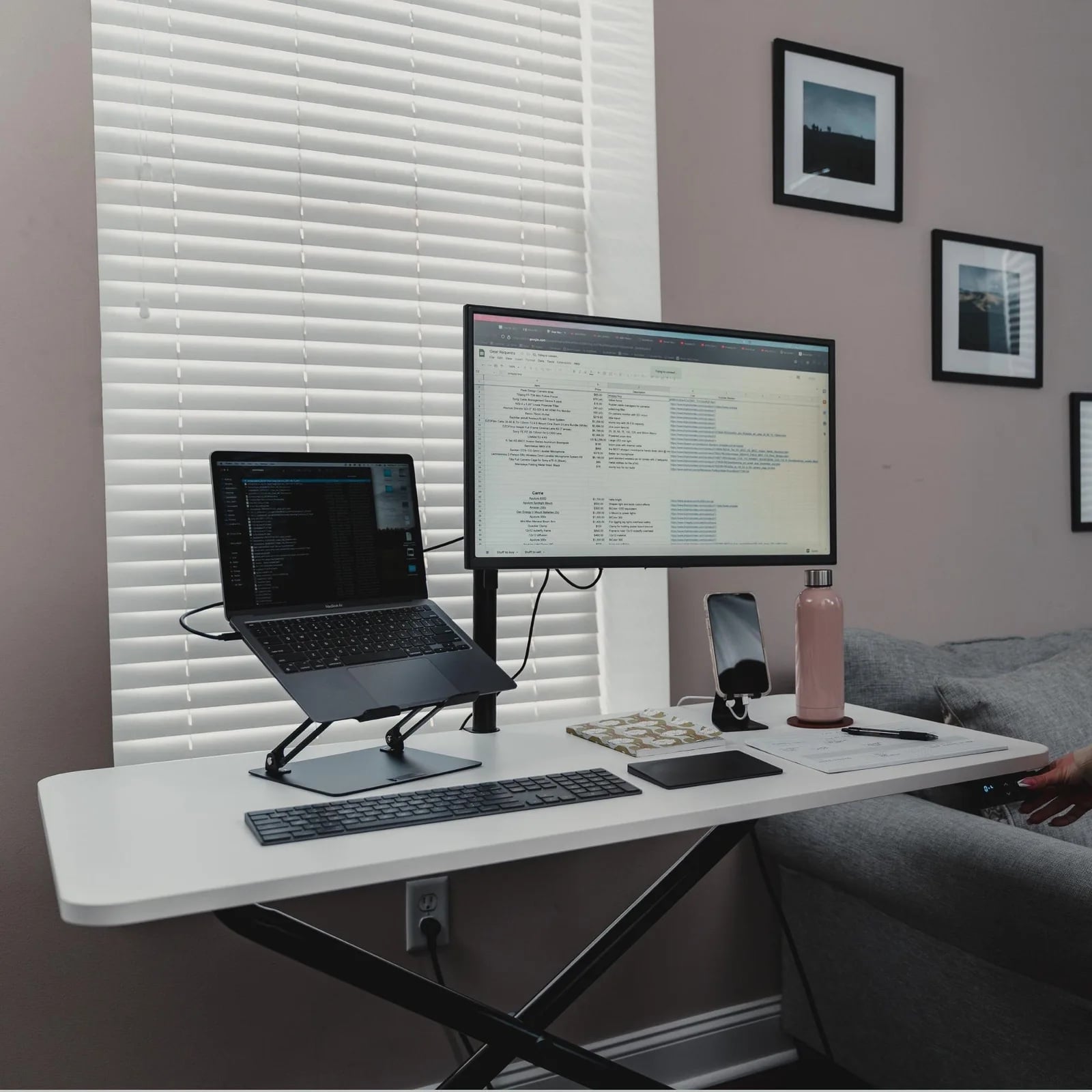
A home worker has no walk-through, no survey and no sensor. They also have constraints an office does not: the desk usually shares a room with something else, the floor is more likely to be hard, and the amount of space available to a working position is frequently the binding limit rather than the budget.
That last constraint shapes the product category more than ergonomics does. Desks sold into small rooms have to justify their footprint when nobody is working, which is why the small-space end of the market has drifted toward designs that fold, store or drop to floor level rather than toward wider height ranges. Lillipad is one of the companies working that end, and its adjustable sit to stand desks are built to reach floor height as well as standing height, which is a span conventional office furniture does not attempt.
Why the Sourcing Matters Even When the Advice Is Fine
There is a reasonable objection to all of this. If the direction is right, who cares whether the ratio has a source?
Two reasons, and both are practical rather than academic.
The first is that an unsourced number cannot be updated. A recommendation traceable to something can be revised when that something is revised. A number that entered circulation by repetition has no mechanism for correction, so it persists unchanged regardless of what is subsequently learned.
The second is that unsourced numbers invite precision that does not exist. Once a ratio is published, people optimize against it, buy equipment to hit it, and judge themselves against it. Precision implies a confidence that nobody actually has about the specific figures, and the confidence is what produces the person standing through discomfort to make a target.
|
What is well supported |
What is not |
|
Long unbroken sitting is worth interrupting |
A specific optimal ratio |
|
Variation in position is better than stillness |
A target number of standing hours |
|
Discomfort while standing is a signal to stop |
That more standing is linearly better |
|
Standing still on a hard surface is tiring |
That the desk alone changes outcomes |
The left column is enough to act on. It is also unglamorous, which is why the right column keeps getting published instead.
What an Honest Recommendation Looks Like
Strip the ratio out and the remaining advice is short enough to be unsatisfying, which is probably why it rarely gets published on its own.
|
Instead of |
Say |
|
Stand for a set number of hours |
Do not hold any single position for a long stretch |
|
Aim for a ratio |
Aim for several changes across the day |
|
Stand more |
Stand in a way you can stop easily |
|
Buy the desk |
Buy the desk, then solve the floor |
None of that fits a headline. All of it survives being asked for a source.
The same logic applies to a single person working at home, minus the budget. Pilot it on yourself for a fortnight, count the adjustments rather than the hours, and fix the floor before concluding the desk was a mistake.
What a Reasonable Deployment Looks Like
For an organization spending real money on this, a few things separate a deployment that works from one that quietly does not.
Do not buy for everybody at once. A pilot on one team, measured by observation rather than survey, establishes an actual adoption rate before the capital is committed across a floor.
Budget for the floor as well as the desk. Anti-fatigue matting is a fraction of the desk cost and it decides whether standing sessions are comfortable enough to repeat. Deployments that skip it see adoption decay across the first month.
Expect cable work. Desks that move need cable management that accommodates the travel, and in an open-plan office with fixed floor boxes that is a real piece of work rather than an afterthought.
Tell people what the desk is for. The most common misunderstanding is that the goal is to stand as much as possible. That produces discomfort and then abandonment. The goal is to change position several times a day, which is a different instruction and an easier one to follow.
Re-check at week three. That is when the drop-off happens, and it is the only point at which intervention is cheap.
The Number Worth Tracking
If a person or an organization is going to track one thing, transitions is the one. It is countable, it is not inflated by memory, it maps directly to the behavior the underlying guidance actually wants, and it is the number that collapses when a deployment has quietly failed.
Standing totals measure a position. Transitions measure whether anything is moving at all, and the second is what the desk was bought for.