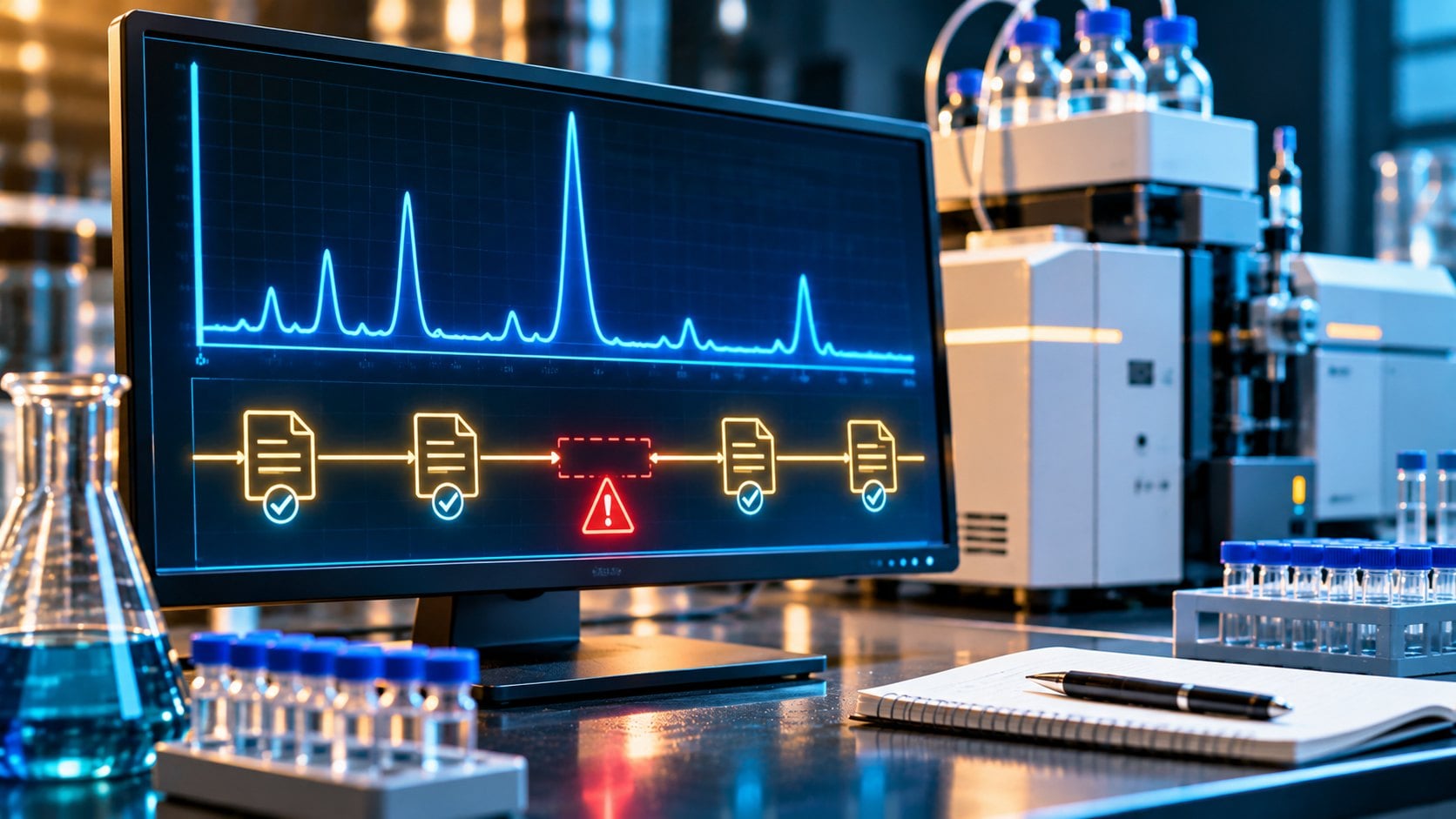

A laboratory computer displays a clean chromatogram, calculates a purity percentage and generates a professional-looking report. The result appears complete. The software has finished processing the measurement, the expected fields are populated and the document is ready for review.
But what happens when another researcher asks how the result was calculated? The original instrument file is missing, the processing method has changed, and nobody can establish which software settings produced the reported number. The report may look complete while the underlying scientific record remains incomplete.
This hypothetical situation illustrates a serious challenge in modern laboratory research. Automation can accelerate data collection and analysis, but it cannot independently guarantee that measurements are accurate, records are traceable or conclusions are justified.
For peptide research, where chemical identity, analytical purity and experimental interpretation are separate scientific questions, understanding the limits of laboratory software is particularly important.
When Laboratory Automation Produces an Answer Without Explaining It
Modern analytical laboratories rely on software to operate instruments, organize measurements and process experimental data. Chromatography systems can automatically identify signals, integrate peaks and calculate numerical results. Laboratory information management systems can associate results with sample identifiers and produce standardized reports.
These technologies reduce repetitive work and can improve consistency when they are properly configured, maintained and controlled.
However, a computerized result is still produced through a collection of decisions. Instruments must be configured, analytical methods selected, reference information entered and processing rules established.
If those decisions are inappropriate, the software may consistently produce results that do not answer the intended scientific question.
Consider a hypothetical peptide sample examined using a chromatographic method. The instrument generates a signal, but the software applies peak detection settings that fail to distinguish two closely overlapping components. The resulting report may contain a single dominant peak and an apparently favorable percentage.
That output would not necessarily establish the absence of another component. It could instead reflect the limitations of the selected method or the settings used to process the data.
The distinction matters because automated analysis can make an unsupported conclusion appear more objective than it really is.
The Difference Between Raw Instrument Data and a Finished Report
Raw analytical data and the final report are related, but they are not interchangeable.
An analytical instrument may create electronic records containing detector responses, measurement sequences, operating conditions and information about the method used. The associated software then transforms some of that information into calculated values or visual summaries.
A PDF report may display the final chromatogram and calculated result while omitting details needed to reconstruct the processing.
The U.S. Food and Drug Administration has addressed this distinction in its guidance concerning regulated pharmaceutical manufacturing and laboratory records. In that context, the agency explains that a printed chromatogram generally does not constitute a complete copy of the associated electronic raw data.
Relevant information can include instrument methods, analytical sequences, integration methods and audit-trail records.
This specific regulatory discussion applies to covered drug-manufacturing operations. It should not be interpreted as proof that every independent research website or educational publisher is governed by the same requirements.
Nevertheless, the underlying scientific lesson is broadly useful: a summary document may present an authentic result without preserving all the information required to explain how it was obtained.
How a Small Software Setting Can Change a Large Scientific Claim
Chromatographic analysis often requires software to distinguish meaningful peaks from background signals. The calculated result depends on appropriate processing decisions, including the determination of peak boundaries and the handling of baseline variation.
Suppose an analyst examines a hypothetical sample containing a dominant component and several smaller detectable signals. The software is configured to ignore peaks beneath a selected threshold.
Changing that threshold may alter which signals are included in the final calculation.
Similarly, modifying the baseline treatment can change how much area is assigned to a particular peak. Two processing configurations can therefore produce different percentages from the same original data.
This does not mean either configuration is automatically invalid. Different analytical methods may require different processing approaches.
The scientific concern arises when processing choices are undocumented, inconsistent or selected primarily because they produce a preferred result.
A reliable analytical method should establish appropriate processing expectations, explain departures when necessary and preserve the connection between the raw measurement and the final calculation.
Without those safeguards, a software-generated percentage may convey more certainty than the underlying evidence supports.
Why Audit Trails Matter More Than Attractive Reports
An audit trail is a record of relevant activity within a system. Depending on the software and applicable requirements, it may document actions such as changes to analytical methods, modifications to records and the timing of those changes.
Audit trails help reviewers understand how an electronic record developed over time.
For instance, an analytical result might initially be calculated using one processing method and subsequently recalculated using revised settings. The final report could display only the revised value.
If the software preserves an appropriate audit history, reviewers may be able to determine that a change occurred and investigate its justification.
Without that history, it can become difficult to distinguish a properly documented correction from an unexplained alteration.
The FDA’s guidance on electronic records and electronic signatures recognizes the importance of trustworthy records and discusses audit trails in relation to applicable requirements and documented risk assessments.
The guidance also describes enforcement discretion concerning certain Part 11 provisions. It does not mean that all organizations are universally required to implement identical audit-trail systems.
The practical scientific principle is that important analytical decisions should remain reviewable, particularly when those decisions can affect the reported result.
The Problem With Laboratory Files That Cannot Be Reproduced
Imagine a researcher receives a final analytical report from a completed experiment. Several months later, a collaborator wants to reexamine the original measurement using updated software.
The collaborator discovers that the report identifies the sample and result but does not preserve the original processing method. The software version is no longer documented, and the raw data cannot be located.
Even if the original result was accurate, independent reassessment may be impossible.
This situation demonstrates why research data management involves more than storing finished reports.
The National Institutes of Health defines metadata as information that helps make scientific data interpretable and reusable. Relevant examples include methodology, data provenance, transformations and information describing how variables were constructed.
Metadata gives another researcher the context required to understand what a dataset represents.
For analytical laboratory work, useful information may include the sample identifier, acquisition method, instrument settings, processing procedure and associated version history.
The exact requirements depend on the research discipline, experimental method and intended use of the data.
A dataset without adequate context may still contain genuine measurements, but its scientific value can be severely limited.
Why Software Validation Is Not a One-Time Guarantee
Software validation examines whether a computerized system is suitable for its intended application. It may include documented testing of system functions, data handling and expected performance.
However, successful validation under one configuration does not establish that every future use of the system will be appropriate.
Applications evolve. Software versions change, processing methods are updated and laboratory workflows are modified.
Those changes may affect the way a system records, calculates or displays information.
A laboratory might introduce a revised data-processing feature that performs correctly under ordinary conditions but behaves differently when presented with unusual or overlapping analytical signals.
Another organization might import an analytical method developed for a different application without fully examining whether it suits the new sample.
Both examples illustrate why software performance must be understood in relation to actual scientific use.
The FDA’s guidance on electronic records and computerized systems discusses validation in relation to a system’s intended use and relevant regulatory obligations.
For general research readers, the broader lesson is that a software vendor’s reputation or a successful installation does not independently establish the validity of a particular experimental conclusion.
Peptide Purity and Identity Require Different Analytical Questions
Software-generated laboratory reports often use technical language that appears definitive. A high purity percentage, for example, may be presented as evidence that a peptide research material has been comprehensively characterized.
Yet analytical purity and chemical identity are distinct characteristics.
Chromatography may provide information about separation and relative detector responses under specified conditions. Mass spectrometry can provide information relevant to molecular mass and identity when appropriately applied.
Neither a clean chromatogram nor a single mass measurement automatically establishes every property of a sample.
Different impurities can respond differently to analytical methods, and some material characteristics may require additional investigation.
Even where analytical identity is supported, it does not establish biological activity, clinical safety or therapeutic effectiveness.
Readers encountering this Wichita research information site should apply the same distinction when reviewing technical discussions. A claim about a chemical measurement must not be interpreted as evidence for an unrelated biological or human-health outcome.
Good scientific reporting identifies exactly what was measured, how the measurement was performed and what remains outside the scope of the conclusion.
When Artificial Intelligence Enters Laboratory Data Analysis
Machine-learning tools can assist researchers by identifying patterns, classifying signals and organizing complex datasets. They may be especially useful when experiments generate quantities of information that are difficult to review manually.
However, a computational model learns relationships from the information and objectives used during its development.
A model trained on one collection of analytical measurements may perform differently when applied to another instrument, sample type or laboratory environment.
This creates a risk when researchers assume that strong performance on familiar data guarantees equivalent performance under new conditions.
Consider a hypothetical system trained to recognize chromatographic patterns. If it repeatedly encounters clean signals during training, it may struggle with noisy or overlapping features that were insufficiently represented.
The model might still produce a confident classification.
That classification would need to be evaluated against suitable reference evidence and the known limitations of the model.
Automated confidence scores should not be confused with independent chemical confirmation.
The relevant safeguards include appropriate testing, monitoring of errors, clear documentation and human review of consequential analytical interpretations.
Why Research Categories Need Accurate Scientific Boundaries
Online scientific resources often group research subjects into broad categories such as metabolism, molecular signaling or weight-related investigation.
Such categories may include discussions of compounds that differ substantially in their research history, regulatory status and level of evidence.
Laboratory findings should not be treated as equivalent to evidence from controlled human studies. A result from cultured cells or a computational model may help researchers develop hypotheses without establishing a clinical benefit.
Readers examining the Peptides Wichita research category should assess the original experimental evidence behind each claim and distinguish investigational compounds from approved prescription medicines.
The presence of a topic on an educational website does not itself establish that a substance is approved, safe or effective for human use.
This distinction becomes especially relevant when software-generated experimental findings are translated into simplified online explanations.
An automated analysis may support a narrow observation about a molecular signal, while the surrounding discussion presents a much broader interpretation.
Scientific communication should preserve the boundary between those statements rather than allowing computational precision to imply clinical certainty.
What Electronic Records Should Preserve for Future Review
Good research records should enable another qualified person to understand the work performed without relying entirely on the memory of the original analyst.
That means retaining information about the materials examined, the methods used, the original observations and the major transformations applied to those observations.
Recordkeeping may also need to account for software configurations, file naming conventions, revisions and the relationship between separate datasets.
The NIH’s Data Management and Sharing Policy, effective January 25, 2023, emphasizes responsible management and appropriate sharing of scientific data generated through NIH-supported research.
The policy does not impose identical data-sharing obligations on every private laboratory or commercial information website.
Nevertheless, its focus on data accessibility, quality and reuse demonstrates why records should be designed for future interpretation rather than merely immediate reporting.
Researchers may need to reexamine an earlier finding after discovering a methodological limitation, changing an analytical method or receiving new evidence.
Accessible and properly documented records make that reassessment possible.
The Business Cost of Poor Laboratory Data Management
Incomplete records can also create operational problems for organizations that depend on analytical information.
When staff cannot locate an original measurement, they may need to repeat work that was previously completed. When method versions are unclear, collaborators may spend additional time reconciling apparently inconsistent findings.
These problems can delay decisions and make it more difficult to investigate quality concerns.
Software systems can help organizations maintain records, but purchasing technology does not replace the need for appropriate procedures.
A laboratory information system still depends on accurate sample identifiers, suitable user permissions, consistent workflows and responsible review of the data it stores.
Likewise, automated reporting does not eliminate the need to establish whether the underlying measurement is scientifically valid.
Organizations benefit when their documentation systems distinguish original records from processed outputs and preserve an understandable history of important changes.
The objective is not to accumulate unnecessary paperwork. It is to maintain enough reliable information to explain decisions and identify problems when they arise.
How Wichita Readers Can Evaluate Laboratory Technology Claims
Readers do not need specialized laboratory software to ask meaningful questions about computerized scientific findings.
They can begin by identifying the precise characteristic being measured. They can then examine whether the research describes its analytical method and explains the connection between the original data and the reported value.
Other useful questions concern software processing, reference information, experimental limitations and the availability of supporting records.
If a report refers to automated analysis, readers can ask whether the automation was evaluated for the particular application.
If the article presents a purity percentage or a biological-response figure, readers should determine which conclusions are directly supported by the underlying experiment.
When information on a website is unclear, a reader may direct questions about research information in Wichita to the publisher through its contact channel.
A publisher’s explanation may clarify its own content, but it should not be mistaken for independent scientific validation of an experiment.
Readers should return to original publications, analytical methods and appropriate primary references when evaluating scientific claims.
A Digital Report Is Only as Reliable as Its Evidence Trail
Laboratory automation has changed how scientists collect, process and communicate experimental information. Sophisticated instruments and software can make complicated measurements easier to handle, compare and report.
However, automation cannot independently determine whether a conclusion extends beyond the evidence.
A polished report may omit the original data, a calculated value may depend on undocumented settings, and a confident software classification may not have been adequately evaluated under the conditions in which it was used.
These limitations do not make laboratory technology untrustworthy. They show why reliable technology must be supported by suitable methods, transparent records and thoughtful scientific judgment.
For peptide research and scientific information more broadly, a convincing result should remain understandable after the software-generated report is set aside.
The strongest evidence is not simply a number displayed on a screen. It is a measurement whose origin, processing, interpretation and limitations can be examined.