
Guest Post
For centuries, medicine was viewed primarily as a biological art—a practice rooted in anatomy, chemistry, and the intuitive experience of the physician. Doctors relied on observation, trial and error, and heuristic knowledge passed down through generations. While this approach has saved countless lives, it has inherent limitations. The human body is not static; it is a dynamic, multi-variable system that often defies simple observation.
Today, we are witnessing a paradigm shift. The next frontier of healthcare isn’t just about discovering new molecules; it’s about the mathematical modeling of human physiology.
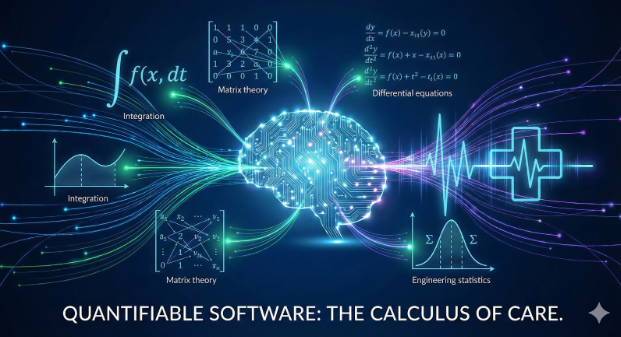
Enter Quantifiable Software: a new breed of medical technology that moves beyond simple data logging. By integrating the rigorous principles of integration, differential equations, matrix theory, and engineering statistics, this software is transforming patient care from an art form into a precise, calculated science. It treats the hospital not just as a place of healing, but as a complex system to be optimized, and the human body as a biological machine whose variables can be modeled, predicted, and managed.
Here is how these four mathematical pillars are maximizing treatment efficiency and saving lives.
1. Differential Equations: Modeling the Rate of Change
In medicine, nothing stays the same. Blood pressure fluctuates, drug concentrations spike and wane, and tumors grow at accelerating or decelerating rates. To treat a patient effectively, a doctor must understand not just the state of the patient now, but the rate at which that state is changing.
This is the domain of Differential Equations.
Quantifiable software utilizes differential equations to model dynamic biological systems. The most critical application is in Pharmacokinetics (PK) and Pharmacodynamics (PD). When a drug is administered, it doesn’t instantly saturate the body. It is absorbed, distributed, metabolized, and excreted.
Software powered by differential equations can calculate these rates in real-time. For example, in an ICU setting, software can model the rate of decay of a sedative in a patient’s bloodstream. By solving these equations, the software can predict exactly when a patient will wake up, or conversely, calculate the precise drip rate required to maintain a steady state of anesthesia without overdosing.
Furthermore, these equations are used to model disease progression. By defining the rate of viral replication versus the rate of immune system response, software can predict the trajectory of an infection, allowing doctors to intervene before a patient hits a critical tipping point.
2. Integration: The Accumulation of Impact
If differential equations tell us about the rate of change, Integration tells us about the total accumulation of that change over time. In the context of Quantifiable Software, integration is essential for understanding the total load on a patient’s system.
Consider the concept of Area Under the Curve (AUC) in toxicology and dosing. A simple snapshot of drug concentration in the blood is insufficient; doctors need to know the total exposure the body has had to a drug over a 24-hour period to avoid toxicity. Quantifiable software performs numerical integration on real-time data streams to calculate this total exposure.
Integration is also vital in radiation oncology. When treating a tumor, the goal is to maximize the radiation dose to the cancer while minimizing exposure to healthy tissue. Software uses integration to sum the total radiation absorbed by tissue volumes, creating 3D dose-accumulation maps. This ensures that the treatment is efficient—destroying the tumor—without causing collateral damage that would delay recovery.
By summing up these infinite small changes, the software provides a holistic view of “total impact,” allowing clinicians to make decisions based on cumulative data rather than isolated data points.
3. Matrix Theory: Organizing the Complexity of Life
A single patient generates gigabytes of data: genomic sequences, blood panel arrays, heart rate variability, and imaging voxels. When you multiply this by thousands of patients in a hospital system, the data becomes unmanageable for the human brain.
This is where Matrix Theory (Linear Algebra) becomes the backbone of efficiency.
In Quantifiable Software, patient data is treated as high-dimensional vectors and matrices. This allows for the simultaneous processing of thousands of variables.
- Medical Imaging: CT scans and MRIs are essentially massive 3D matrices of numbers. Matrix operations (transformations, eigenvalues) are what allow software to reconstruct these numbers into visual slices of the brain or heart, identifying abnormalities that the human eye might miss.
- Resource Allocation: On an operational level, hospitals use matrix-based linear programming to solve optimization problems. If a hospital has X beds, Y nurses, and Z surgeries scheduled, matrix theory helps calculate the optimal allocation of these resources to minimize wait times and maximize patient throughput.
By reducing complex biological and operational problems into matrix equations, the software can solve for “efficiency” mathematically, ensuring that the right patient gets the right care at the right time.
4. Engineering Statistics: Reducing Risk and Predicting Outcomes
Medicine is inherently uncertain. No two bodies react exactly the same way. However, uncertainty can be managed. Engineering Statistics applies the rigor of industrial quality control to healthcare.
Quantifiable software moves beyond simple averages. It utilizes:
- Six Sigma methodologies: To identify and eliminate defects in the care delivery process.
- Confidence Intervals and Hypothesis Testing: To determine if a treatment is actually working or if a change in vitals is just statistical noise.
- Predictive Reliability: Just as engineers predict when a machine part will fail, this software uses statistical survival analysis to predict patient readmission risks or the likelihood of sepsis.
For instance, by analyzing the statistical variance in a patient’s heart rate (not just the rate itself), the software can detect subtle statistical anomalies that precede a cardiac event by hours. This moves treatment from reactive (treating the heart attack) to proactive (adjusting medication to prevent the statistical probability of the attack).
The Synthesis: A New Standard of Efficiency
The magic of “Quantifiable Software” is not in any single one of these math fields, but in their integration.
Imagine a scenario:
- Matrix Theory organizes a patient’s genetic and historical data to identify them as a high-risk candidate for a specific medication.
- Differential Equations model how that specific medication will metabolize in their unique liver function.
- Integration calculates the precise cumulative dose required to kill the infection without harming the kidneys.
- Engineering Statistics constantly monitor the patient’s vitals against thousands of similar cases to flag any deviation from the expected recovery curve.
This is the future of treatment efficiency. It is a future where we stop guessing and start calculating. By harnessing the power of mathematics, we are not removing the humanity from medicine; we are giving doctors the ultimate tool to protect it.
We are moving from the practice of medicine to the engineering of health.