
What this covers
The Moisture Meter, in Two Quite Different Versions
The Thermal Camera Does Not See Water
The Borescope, for When the Alternative Is a Hole
Why Huntington Beach Makes the Sub-Slab Question Live
The Laboratory Is a Separate Discipline
Why the Person Holding the Instruments Should Not Be Selling the Repair
Most of what matters in a damp building is behind something. That is the entire difficulty. A visual inspection documents the consequences and almost never finds the cause, because the cause is inside a cavity, under a floor or above a ceiling.
Four instruments do most of the real work, and each of them answers one narrow question. Understanding what each measures, and what it does not, is the difference between a finding and a guess dressed up as one.
The Moisture Meter, in Two Quite Different Versions
There are two kinds and they do not measure the same thing.
A pin meter pushes two probes into the material and measures electrical resistance between them. Water conducts, dry material does not, so lower resistance means wetter. It is direct, it is reliable, and it puts two small holes in whatever is being tested. It also only reports on the depth the pins reach.
A pinless meter sits flat against the surface and reads the dielectric constant of the material underneath, typically to a depth of around three quarters of an inch. It leaves no mark and it scans quickly, which makes it the right tool for sweeping a large area to find where to look closely.
They disagree, routinely, and the disagreement is informative rather than a fault. A pinless meter reading high over a stretch of wall where pin readings come back dry usually means the water is deeper than the pins went, or that something in the wall construction is skewing the field. Reading one instrument alone and reporting the number is how a confident wrong answer gets produced.
Both are calibrated for particular materials. A reading taken on plaster using a wood scale is a number, not a measurement.
The Thermal Camera Does Not See Water
This is the most common misunderstanding in the whole field, and it matters.
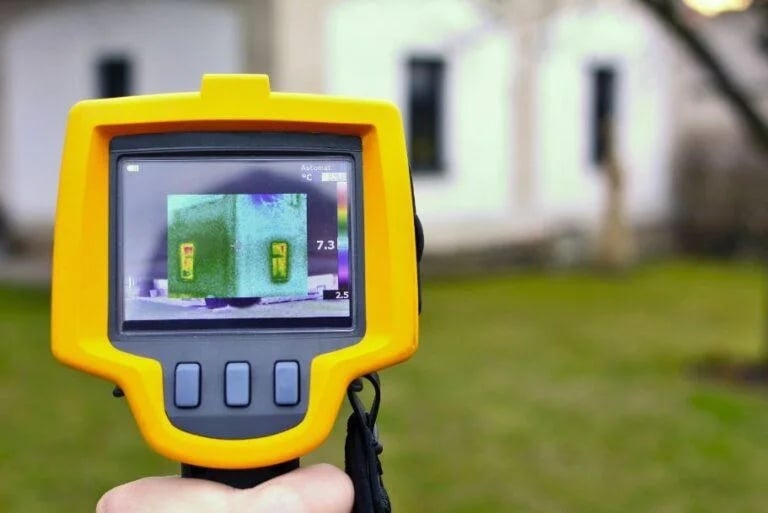
An infrared camera measures surface temperature. It does not detect moisture, it has never detected moisture, and it cannot see through anything. What makes it useful is a side effect: evaporation cools a surface, so wet material is usually slightly colder than the dry material around it, and that temperature difference shows as a cool patch on the image.
Usually. Not always, and the exceptions are the point.
A camera needs a temperature differential to work with. On a mild day with no heating running and no sun on the wall, a damp patch and a dry patch can sit at the same temperature and the image shows nothing. The same scan an hour after the heating comes on can light the whole thing up. Scanning a building under the wrong conditions and reporting it clear is a real failure mode.
It also produces false positives constantly. A cold spot can be missing insulation, a stud, a duct run, a draft through a gap, or a shaded exterior behind the wall. None of those is water. A thermal anomaly is a place to put a moisture meter, not a result.
Anyone presented with a thermal image as a finding, rather than as the reason a second measurement was taken, is being shown a picture rather than told an answer.
The Borescope, for When the Alternative Is a Hole
Once meters and thermal imaging agree there is water inside a specific cavity, somebody has to decide whether to open it.
A borescope is a lens on a flexible tube that goes in through a hole a pencil would fit in. It shows the inside of the wall cavity, the back face of the finish, the sub-floor void, the space above a ceiling. In a property where opening the wall means repair work, plaster, paint and a week of disruption, the small hole is the proportionate step.
It also settles arguments quickly, which matters in a tenancy dispute or a transaction, because a photograph of the inside of a cavity is not something anyone has to take on trust.
Why Huntington Beach Makes the Sub-Slab Question Live
The coastal plain under Huntington Beach has a shallow water table, managed actively by the city and the surrounding Orange County water districts precisely because groundwater levels there are a live engineering matter rather than a theoretical one.
For a property on a slab, that changes which question comes first. Moisture arriving through concrete from below behaves differently from moisture arriving through a roof or a pipe. It is slower, it is broader, it does not correspond to any obvious event, and it tends to present as flooring lifting or a baseboard darkening along a run of wall rather than as a discrete stain.
A mold inspection in Huntington Beach that does not consider the slab as a moisture path on a property built that way has skipped the most likely explanation on the plain.
The Laboratory Is a Separate Discipline
Everything above happens on site and establishes where water is. None of it identifies what is growing.
That requires sampling, and sampling only makes sense once the site work has given somebody a reason to sample a specific place. Air and surface samples go to an independent accredited laboratory where particles are identified under polarized light microscopy and counted.
Two things decide whether the result means anything. The first is an outdoor control taken the same day with the same equipment, because outdoor air carries spores and an indoor number without a local baseline cannot be called elevated or normal. The second is species identification, because Cladosporium and Penicillium turn up in ordinary buildings while Stachybotrys needs weeks of sustained wetness and therefore says something about the building’s history.
A laboratory reports what was in the air. It does not report what is wrong with the house. That conclusion comes from putting the instruments and the laboratory together.
Why the Person Holding the Instruments Should Not Be Selling the Repair
A final point about who reads the numbers.
The same firm very often inspects and then sells the remediation. Every instrument described here involves interpretation, and interpretation is where a commercial interest does its quiet work. A thermal anomaly can be reported as a concern or as a stud. A borderline moisture reading can be called elevated or normal.
An inspector who does not perform removal has nothing riding on which way those calls go, and can reach the conclusion that nothing needs doing. That is not a minor difference in a field where the diagnosis and the invoice are usually written by the same hand.
Coverage and contact details for the practice referenced above are on its Google Business Profile.