
What this covers
What the Tail Seal Does
Why the Grease Matters as Much as the Brushes
The Properties Labs Measure
Reading the Results Together
Testing Beyond the Drum
Questions to Ask a Grease Supplier
How the Grease and Brushes Work as a Pair
Matching the Grease to the Drive
Common Causes of Seal Trouble
What to Watch on Site
The Short Version
Tail seal grease is easy to overlook. It arrives in drums, it gets pumped into the brushes, and nobody thinks about it until water or grout shows up inside the shield.
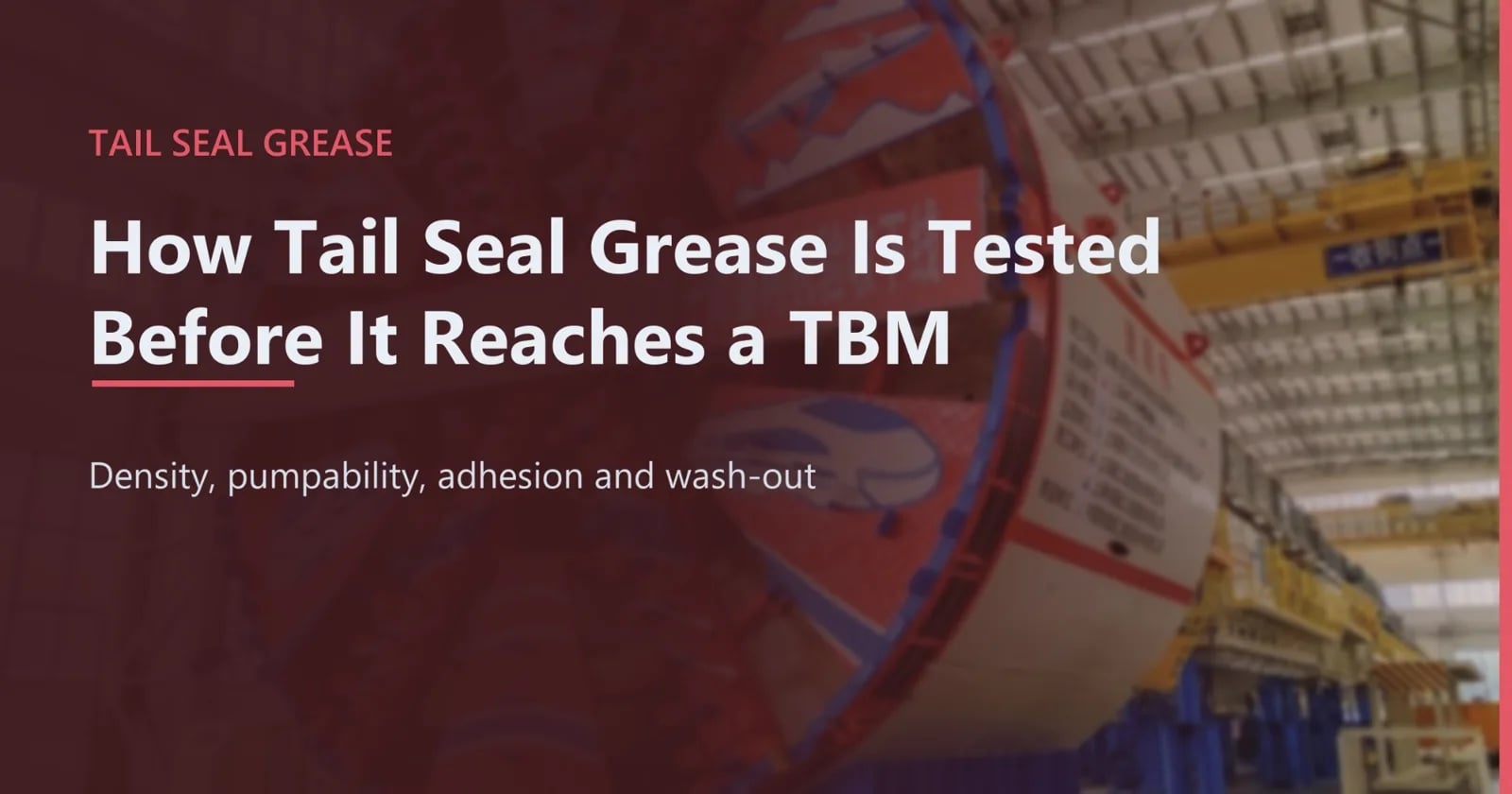
If you specify or buy grease for a tunnel boring machine, the properties that labs test tell you a lot about how it will behave months into a drive.
What the Tail Seal Does
The tail seal sits at the back of the shield, in the gap between the tail shield and the segment lining. It is usually made up of rows of brushes, with grease packed into the spaces between them.
The seal has one job: keep backfill grout, groundwater and soil from entering the machine. The brushes hold their shape and contact. The grease fills the gaps between bristles and between rows, and it carries the pressure.
If the seal fails, water, soil and grout can enter the machine. At depth or in water-bearing ground, that can stop the drive.
A leak at the tail is also one of the harder problems to fix in place. The seal is behind the machine and inside the lining, so access is limited, and work to repair it usually means stopping the drive. Most crews would rather spend the effort up front choosing and filling the grease correctly than spend it later at the tail with water coming in.
Why the Grease Matters as Much as the Brushes
Brushes do not seal on their own. Bristles leave gaps, and the only thing filling those gaps is grease.
That means the grease has to stay in place under pressure, stick to steel and bristles, resist being washed out by water and grout, and still be pumpable through the machine’s lines. Those demands pull in different directions, which is why testing matters.
The pressure on the seal also changes over the drive. Depth changes, groundwater levels change, and the backfill grout behind the rings pushes harder when it is injected at a higher rate. A grease that copes at the start of a drive may be working at its limit halfway through, which is one more reason to look at the full set of properties rather than the easiest one to sell.
The Properties Labs Measure
Grease performance analysis usually covers the following. Each test answers a different question.
|
Property |
What it tells you |
|
Density |
How much grease fills a given volume, which affects consumption |
|
Consistency |
How stiff the grease is, and whether it holds its place under pressure |
|
Pumpability |
Whether it moves through the lines at site temperatures without blocking |
|
Malleability |
Whether it deforms to fill gaps as the shield and lining move |
|
Adhesion |
Whether it sticks to brushes and steel instead of being pushed out |
|
Vertical wash-out |
How well it resists being carried away by flowing water |
|
Water sealing ability |
Whether it holds back water under pressure |
A grease can score well on one property and poorly on another. A very stiff grease may seal well but pump badly. A very soft grease may pump easily and wash out fast.
Reading the Results Together
Look at the results as a set rather than one at a time.
High wash-out resistance with good adhesion suits water-bearing ground.
Good pumpability with adequate consistency suits long drives with long feed lines.
Good malleability helps on curves, where gaps between shield and lining change shape.
If a supplier only quotes one or two properties, ask for the rest. The missing ones are often the ones that matter on your drive.
Ask how each test was run as well as what the result was. Wash-out and water sealing results depend on the pressure and the duration of the test, and two numbers from different methods are not comparable. A supplier with its own laboratory should be able to explain the method in a sentence or two.
Testing Beyond the Drum
Lab tests describe the grease as delivered. Site conditions add variables: temperature, the grout mix, the water chemistry and how the brushes were filled.
Some tunneling materials suppliers offer performance analysis on grease already on site, with feedback on quality and steps to reduce the chance of a serious incident in use. That is worth knowing about if a seal starts to misbehave partway through a drive.
Main-bearing sealant gets a similar treatment. Tests cover density, consistency, pumpability, adhesion, water resistance and water pressure sealing, plus a dynamic leakage test, because the main bearing seal has to fill gaps formed while the cutterhead turns.
Questions to Ask a Grease Supplier
Which of the properties above have you tested, and can I see the results?
What ground and water pressure was the grease used in on previous projects?
Is the grease approved by any TBM manufacturer?
What is the lead time to the jobsite?
Is a safety data sheet available before delivery?
Lead time deserves attention. Two months to the jobsite is a real figure for one supplier, so grease ordering belongs early in the procurement plan.
It also helps to plan for the whole drive, not just the first delivery. Consumption on a long drive can run well past the first order, and a seal that runs short of grease halfway through is a seal that starts to leak. Agree a reorder point with the supplier before launch.
How the Grease and Brushes Work as a Pair
Grease and brushes are designed to work together. A brush rated for a given depth assumes the grease is filled at the right rate and has the right characteristics. The rating is a system rating, not a brush rating, and it only holds when the whole system is in place.
So when you assess a grease, check what brushes it has been used with. When you assess brushes, check which grease they were rated with. Mixing products without that check is one way seals underperform.
One example of a matched pair is a TBM tail seal grease formulated for washout resistance, described as highly anti-washout with strong adhesion to the brushes and efficient pumpability, and made from a blend of fiber types, specialized oils and fillers. It is used together with tail seal brushes designed for TBM sealing to form a barrier against backfill grout, water and soil. Both are supplied by Balsam Laboratory, which states more than 27 years of grease experience and OEM approval from CREG.
Matching the Grease to the Drive
The same grease will not suit every drive. Ground, depth, water pressure and alignment all change what the seal has to survive.
|
Drive condition |
What it asks of the grease |
Property to look at first |
|
Water-bearing, permeable ground |
Stay in place against moving water |
Vertical wash-out, water sealing |
|
Deep alignment, higher water pressure |
Carry pressure without being pushed out |
Consistency, water sealing |
|
Long drive, long feed lines |
Move through the lines all shift |
Pumpability |
|
Tight curves |
Fill gaps that change shape |
Malleability, adhesion |
|
Stable, straightforward ground |
Seal reliably at lower consumption cost |
Density, consumption per ring |
Some suppliers offer more than one formulation for this reason: a premium line, and an economy line that uses more grease per ring but suits stable, straightforward ground. Compare the cost over the whole drive rather than per drum, because consumption changes the answer.
Common Causes of Seal Trouble
When a tail seal leaks, the grease is often blamed first. Sometimes it is the cause. Often it is one of several.
Underfilling is common. If the chambers between brush rows are not kept full, the brushes carry pressure they were not designed to carry alone. Consumption that looks pleasingly low can be a warning, not a saving.
Long stoppages are another. Grout and water keep pushing while the machine sits still, and a grease with weak wash-out resistance loses ground every hour.
Damaged brushes are a third. Brushes worn on a curve or bent at launch leave larger gaps for the grease to fill.
Finally, mismatched products. A brush rated with one grease and filled with another may not behave as rated.
What to Watch on Site
Testing reduces risk. It does not replace watching the seal during the drive.
Track grease consumption per ring and look for sudden changes.
Check for grout or water at the tail, especially after long stops.
Watch pressures in the grease lines for signs of blockage.
Note the ground at the time of any change, since consumption often follows ground.
A sudden rise in consumption often means grease is being pushed out or washed away. A sudden drop can mean a blocked line and an empty chamber.
Keep the records simple and consistent: grease per ring, line pressures, ground type and any stoppages. Read alongside each other, those four columns usually explain a seal problem before anyone has to open the tail. They also give you a fair basis for comparing greases if you change product partway through a project.
The Short Version
Tail seal grease carries the pressure in the seal. It has to stay in place, stick to the brushes, resist wash-out and still pump.
Ask for test results on density, consistency, pumpability, malleability, adhesion, wash-out and water sealing. Read them together, match the grease to the brushes, order early, and watch consumption on site.