
The call almost always comes at a bad hour, and the first thing a family wants to know is how fast this can be over. The assumption underneath the question is that bail is a price. Pay it, and the person comes home.
In Louisiana, that assumption runs into two provisions of the Code of Criminal Procedure that most people have never heard of until the night they need them. Both of them pause for weekends.
The 72 hours that are not 72 hours
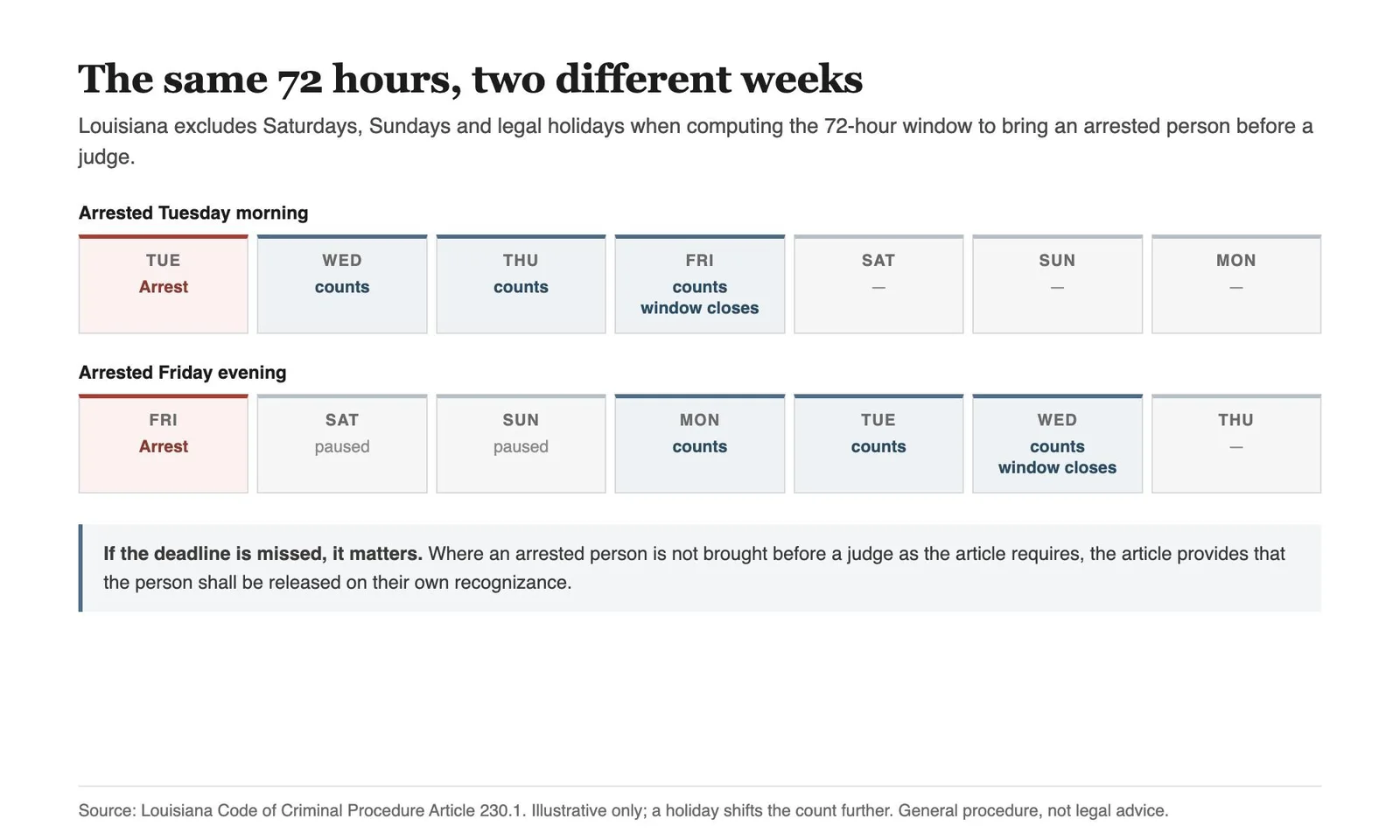
Article 230.1 sets the outer limit on how long someone can sit before seeing a judge. The officer with custody must bring the arrested person before a judge, for an appointment, within 72 hours of the arrest.
Then comes the sentence that changes the arithmetic entirely. Saturdays, Sundays, and legal holidays are excluded from computing the seventy-two-hour period.
So the clock is not seventy-two hours on a wall. It is seventy-two business hours.
Work through a Friday evening arrest. Friday night barely counts. Saturday and Sunday do not count at all. The count effectively resumes Monday, which can put that first appearance into the middle of the following week. The same arrest on a Tuesday morning runs a completely different course, and nothing about the case is different—only the day of the week.
A real consequence is attached, and it runs in the arrested person’s favor. If the person is not brought before a judge as the article requires, the article provides that they shall be released on their own recognizance. The deadline is not advisory.
The second clock, in domestic cases
The other provision is Article 313, known as Gwen’s Law. It exists because a woman was killed by her estranged husband after he was released on bond in a domestic abuse case, and the legislature decided that category of case needed a look before bail was set rather than after.
Under it, a contradictory bail hearing may be held before bail is set at all, for a person charged with domestic abuse battery, violation of a protective order, stalking, or any felony involving the use or threatened use of force or a deadly weapon against a family member, household member, or dating partner.
Two words do most of the work: before and may.
Before, because this is not an appeal against a bail amount already set; it happens first, and in the meantime there is no number to post.
May, because it is not automatic. The court decides whether to order the hearing. Families in identical-looking situations can have very different first weeks depending on that decision.
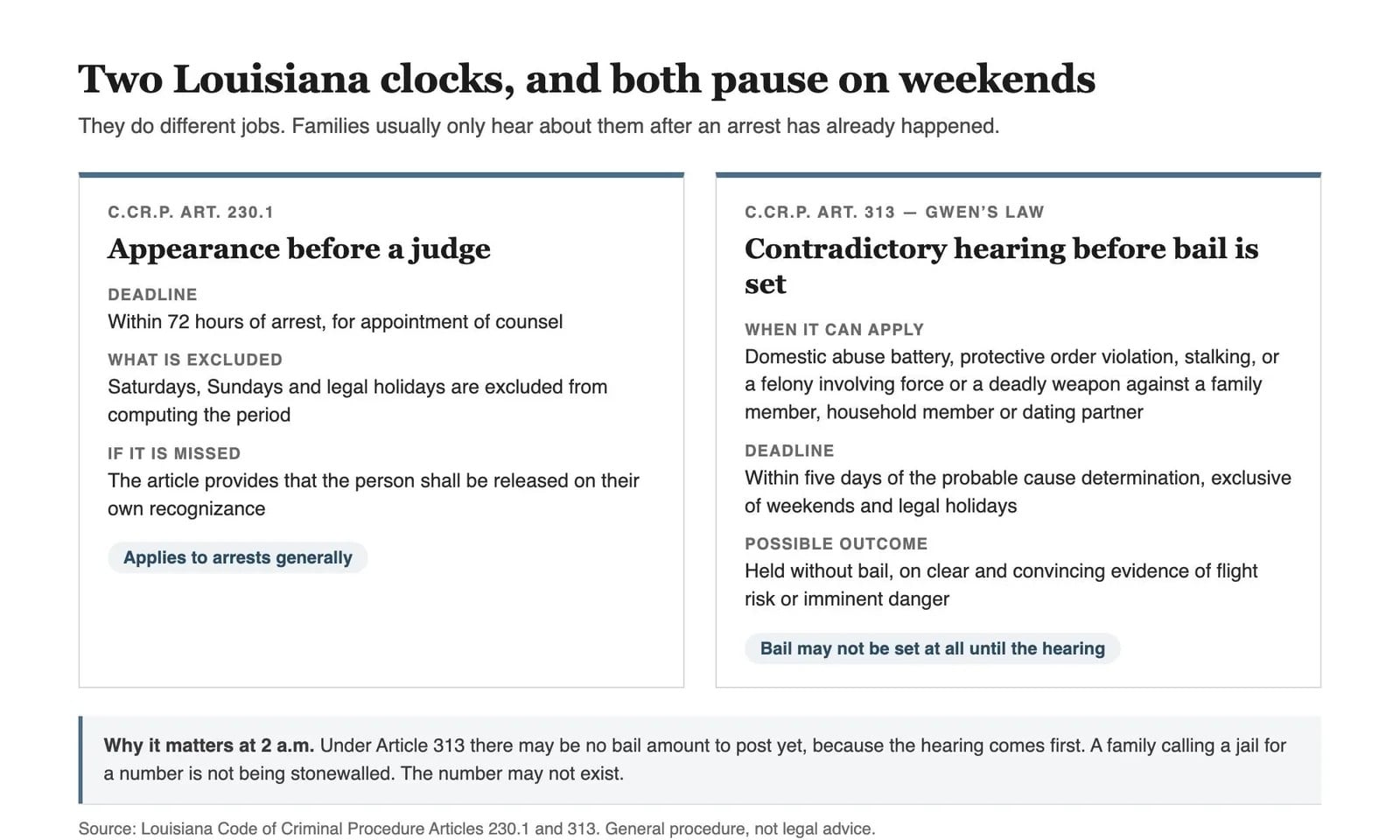
If the court does order it, the hearing must be held within five days of the determination of probable cause, and weekends and legal holidays are excluded.
At that hearing, the court can order the person held without bail entirely. That requires proof by clear and convincing evidence that the person might flee or poses an imminent danger to another person or the community. It is a real standard rather than a formality, but the outcome is that in this category of case, bail is genuinely not guaranteed to exist.
None of that is a defect in the system. It is the deliberate design, written after a death. But a family calling around on a Saturday looking for a bond amount that has not been set, and may not be set, deserves to understand why rather than concluding that somebody is stonewalling them.
Why the parish is the first question, not the last
Both of these provisions are statewide. Almost nothing else about the process is.
Louisiana runs its jails at the parish level. Each parish has its own facility, booking desk, inmate lookup, visitation and property rules, and answers who picks up the phone at two in the morning. No single statewide portal lets a family check.
That is why the practical first step is not calling a bondsman. It is establishing which parish is holding the person, because that determines the facility, the court, and everything downstream. A parish-by-parish index of Louisiana jail lookups and contacts is a more useful thing to have open at that hour than a general explainer about how bail works.
Booking also takes time. A person can be genuinely in custody and not yet appear in any lookup system. Families reasonably conclude they have the wrong parish when the honest answer is that the paperwork has not caught up.
What this means practically
Three things follow from the two clocks.
The day of the week is a real variable. A Friday or holiday-weekend arrest is structurally slower than a Tuesday one. That matters before anyone promises a worried relative they’ll be home tonight.
In domestic cases, there may be no number yet. If the court orders a contradictory hearing, there is nothing to post until it happens. Understanding how a domestic violence arrest changes the bail process in Louisiana is more useful than repeatedly asking a jail for a bond amount that does not exist yet.
Establish the parish before anything else. Every other question depends on it, and it is the one thing a family can usually determine quickly.
The process is slower and more parish-specific than most people expect. Knowing which clock is running, and that it pauses on Saturday, is the difference between an anxious weekend and an anxious weekend spent doing something useful.
Clint L. Sanchez is the founder of BlakSheep Creative, a Louisiana web design and marketing agency. This article is a sponsored contribution and contains links to a client’s website. It describes general procedure and is not legal advice.